On Gifting
· rituals, frameworks
I love gifts. I think we should give far fewer of them.
The Irrationality of Gifting
One of the ten principles of Burning Man is gifting. The gifting economy of Burning Man is sometimes misunderstood as barter, but barter is almost the opposite idea. Barter is an exchange: I give you something because you will give me something in return. A gift, at least in its ideal form, has no such ledger. You give because you want another person to have something.
There is something beautiful about this. Perhaps even slightly irrational.
Most of economic life is organized around exchange. Goods and services have prices; favors create debts; transactions are completed when value flows in both directions. Gifting suspends that logic. The giver gives up something of value without requiring compensation.
Of course, human beings are complicated, and few acts are entirely free of self-interest. Giving feels good. It strengthens relationships. It can confer status or create an expectation of reciprocity later. Anthropologists have spent a great deal of time pointing out that gifts can create obligations of their own.
Still, there is an important difference between I gave you this because I wanted you to have it and I gave you this because it was my turn.
Modern gift culture too often collapses the first into the second.
The Gift Tax
We have constructed an elaborate social calendar of occasions on which gifts are due.
Birthdays. Weddings. Graduations. Anniversaries. Holidays. Dinner invitations. Housewarmings. Baby showers.
The rules vary by culture and relationship, but the basic structure is familiar: an event occurs, and convention dictates that one should arrive with something.
At this point, generosity starts to resemble a tax.
The question is no longer, *What would this person genuinely value?* It becomes, *What am I supposed to bring?*
Hence the bottle of wine.
Wine is almost perfectly designed for obligatory gifting. It is respectable, consumable, easy to buy at almost any price point, and requires relatively little knowledge of the recipient. It also might be completely useless. Perhaps they do not drink. Perhaps they already have too much wine. Perhaps they care enough about wine that the random bottle you selected is exactly the bottle they do not want.
But the social obligation has been satisfied.
I remember receiving gifts for my high school graduation that I had no use for at all. The people giving them to me were being generous. They spent real money because they cared about me and wanted to celebrate something important in my life.
And yet somehow all that generosity produced a pile of stuff I did not want.
The Deadweight Loss of Gifting
Milton Friedman described four ways to spend money, depending on whose money is being spent and who receives the benefit. The further you get from "my money on me," the weaker the incentives to care about both price and preference, and the more likely resources are to be misallocated. His framework was intended largely as an argument about government spending, but one quadrant contains a useful theory of gifting.
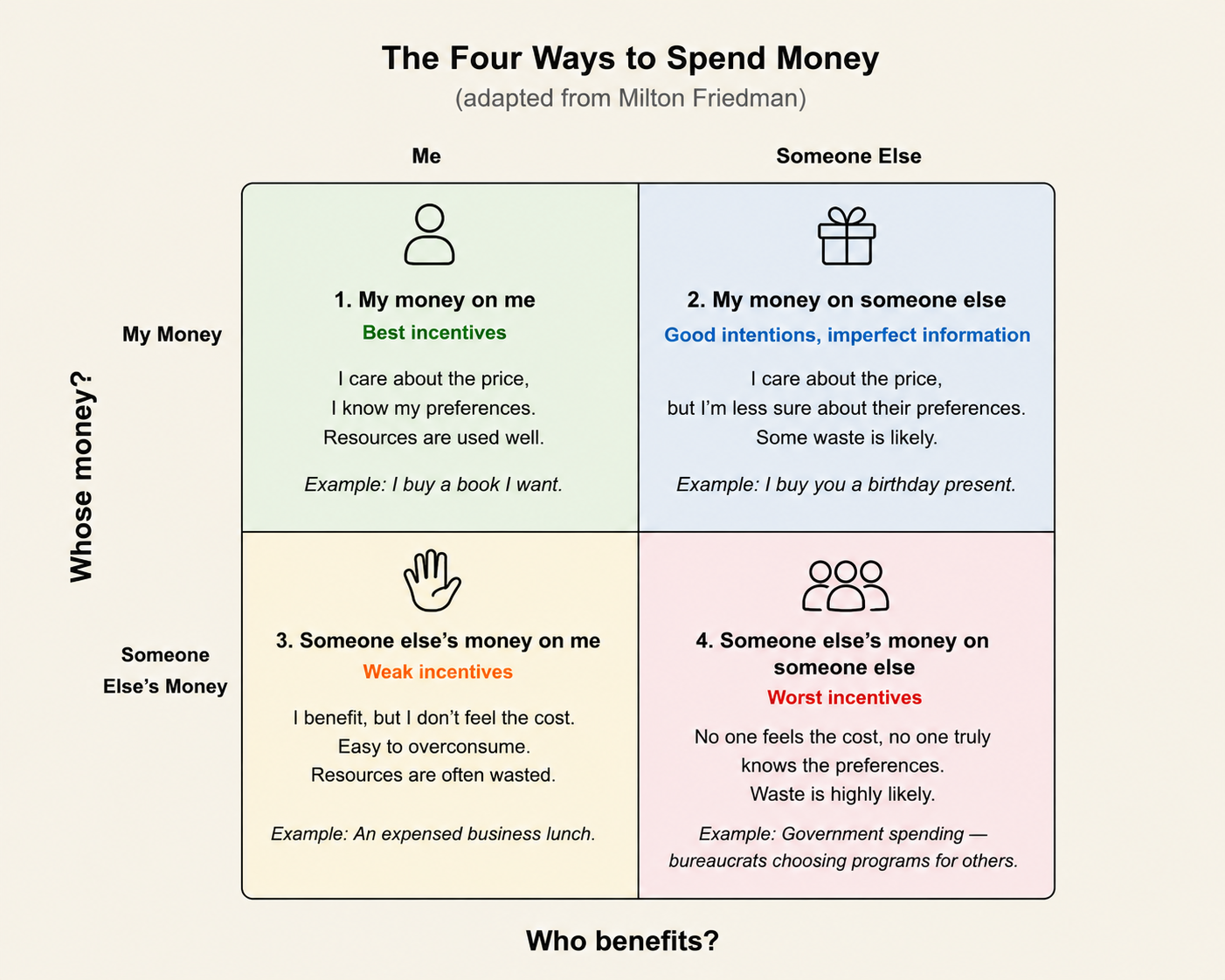
When I spend my money on someone else, I still care about the price, but I have less information about what the recipient values. That is the economic problem at the heart of gift-giving. A thoughtful gift succeeds when the giver manages to overcome that information gap: by knowing the recipient well, paying attention to what they need, or simply remembering something they once said they wanted.
Economists have occasionally applied the language of deadweight loss to gifts: if I spend $100 buying you something that you would only have paid $40 to own yourself, some value has disappeared in the exchange.
That framing is obviously incomplete. Gifts can carry sentimental value that ordinary purchases do not. A terrible sweater from someone you love may be worth far more to you than its market price.
But as a description of obligatory gifting, the idea is useful.
Every year we spend enormous amounts of money trying to guess what other people want. Inevitably, we guess badly.
The result is not merely wasted money. Unwanted gifts have to be manufactured, packaged, shipped and stored. They become clutter. They get returned, donated, regifted or eventually thrown away.
We have responded to this problem, in part, by increasingly giving money instead.
This is more efficient, but sometimes reveals the absurdity of the underlying system.
Suppose two friends have roughly similar incomes. I give you $100 for your wedding. A year later you give me $100 for mine. We have now successfully transferred $200 between ourselves and ended up approximately where we started.
There are obviously situations where monetary gifts matter enormously. A young couple marrying and starting a household may genuinely benefit from transfers from older or wealthier relatives. Gifts can move resources from people with more to people who need them more, and traditions built around that function can be deeply valuable.
But among peers, the reciprocal exchange of money can start to look less like generosity and more like accounting.
The gift has become a debt.
The Gifts I Remember
Strangely, many of the best gifts I have received arrived on no occasion at all.
A friend saw something and thought I would like it. Or noticed a small problem in my life and found something that would solve it. There was no birthday, no holiday, and no requirement that anything be reciprocated.
Those gifts are memorable partly because they reveal something beyond generosity: attention.
Someone was paying attention to what I liked, what I needed, or who I was.
The best handmade gifts go even further. Their economic value may be trivial, but they contain something much scarcer than money: another person's time. Someone chose to spend a portion of their finite life making something specifically for you.
This is why I don't think the value of a gift can be measured particularly well by its price.
The value is often in the information embedded inside it.
*I noticed this about you. **I remembered. *I thought you would like this.
A good gift is evidence that someone was paying attention.
Give Less, Give Better
None of this makes me opposed to gifting. Quite the opposite.
I would simply like gifts to become less frequent and more meaningful.
I want to give something when I come across the perfect thing for someone I care about. When I can make something they would love. When I know something would materially improve their life. When they need help. Or sometimes simply because giving it would make both of us happy.
But I want to escape the ledger; you gave me something, therefore I owe you something. Your birthday occurred, therefore I must buy something. I am coming to your house, therefore I must arrive carrying an object.
The more gifting becomes governed by obligation and reciprocity, the more it begins to resemble an ordinary transaction - with worse price discovery.
The ideal of the gift is almost the opposite:
Give when you feel moved to give. Give something useful, beautiful, strange or deeply personal. Give something expensive if the expense matters, and something worthless if it does not. Give your money, your time, your attention or your effort.
And when there is nothing worth giving, give nothing.
A world with fewer gifts might, paradoxically, contain more generosity.