The Trilemma of Health
· frameworks, wellbeing
Today is my birthday!!! 🎉🎉🎉 On the occasion of my latest trip around the sun, I like to reflect on how my life is going. The essay below is my attempt to outline a framework I've been using to think about this question over the past few years.
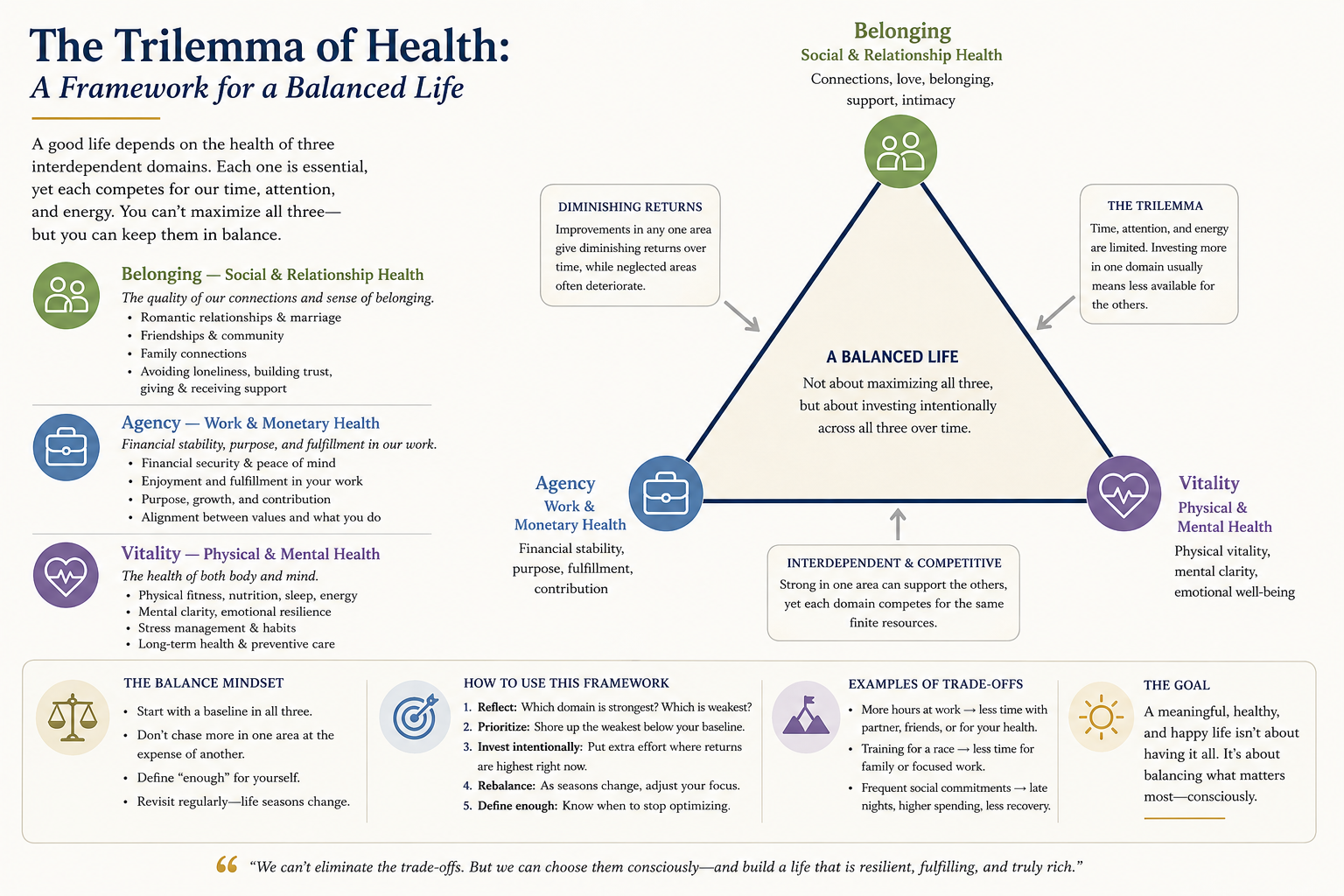
The Trilemma of Health
When I try to assess how well my life is going, I usually end up asking some version of three questions:
- Do I have strong relationships and people with whom I can share my life?
- Do I feel secure, purposeful, and fulfilled in my work?
- And do I have the physical and mental capacity to live the life I want?
I think of these as the three domains of health:
- Belonging: social and relationship health.
- Agency: work and monetary health.
- Vitality: physical and mental health.
Together, they form what I call the Trilemma of Health.
I borrow the term “trilemma” from international monetary economics. Mundell’s “unholy trinity” describes three economic goals that a country cannot fully pursue at the same time. Life is not governed by such a precise rule, but it presents a similar problem: belonging, agency, and vitality are all worth pursuing, yet each demands resources that are limited—mostly our time, attention, and energy.
It is difficult to maximize all three at once.
Belonging: social and relationship health
Belonging refers to the quality of our relationships: with a spouse or romantic partner, family, friends, and a broader community.
It is not simply a measure of how many people we know or how full our social calendar is. The more important questions are whether we feel known, whether we have people we can depend on, and whether we have people with whom we can meaningfully share our lives.
At its weakest, poor relational health shows up as loneliness, conflict, isolation, or the feeling that our relationships are mostly surface-level.
Agency: work and monetary health
Agency combines financial security with purpose and fulfillment in our working lives.
Money is part of this because financial insecurity can exert enormous pressure on nearly every other part of life. Having enough money creates stability, choice, and some control over the future.
But money alone is not enough. Work also affects our sense of competence, progress, identity, and contribution. A person can be financially comfortable but feel that their work is empty. Another can find their work deeply meaningful while living under constant financial stress.
Agency is about whether we feel capable of directing our lives, and whether the way we spend our time feels worthwhile.
Vitality: physical and mental health
Vitality includes the health of both body and mind.
It includes the obvious medical measures: illness, strength, mobility, endurance, energy, and sleep. But it also includes emotional stability, resilience, and the ability to handle stress.
The purpose of vitality is not simply to avoid disease or achieve an impressive collection of health metrics. It is to give us the capacity to participate fully in our own lives.
The tradeoffs between them
The three domains are deeply interdependent.
Strong relationships can improve mental health and make periods of professional difficulty more manageable. Financial security can reduce stress and create more time for exercise, family, and friends. Good physical health can make us more effective at work and more present in our relationships.
But the same domains also compete with one another.
The person who works late every night may advance professionally while slowly neglecting friendships, sleep, or exercise. Someone training intensely for an athletic goal may improve their physical health while having less time for a partner or family. A rich social life may come with late nights, frequent travel, greater spending, and less focused time for work.
This is what makes the framework a trilemma rather than merely a checklist. An hour spent in one domain usually cannot be spent in another. Over short periods, we can compensate by sleeping less or spending more. Over longer periods, the tradeoffs become harder to escape.
The danger of maximizing
The problem is often not that we ignore all three domains. It is that we continue maximizing one long after it has become healthy enough.
The benefits of improvement tend to diminish.
Moving from financial insecurity to stability can transform a life. Moving from stability to greater comfort can still matter. But at some point, we come face to face with diminishing marginal returns. The same is true for the other two domains.
Meanwhile, the weakest domain can overwhelm success in the others. Professional achievement is difficult to enjoy while profoundly lonely. Loving relationships cannot eliminate the strain of severe financial insecurity. Wealth and friendship cannot fully compensate for debilitating physical or mental illness.
This suggests a different way of allocating effort: *Before trying to maximize any one domain, make sure the other two have not fallen below an acceptable floor.*
Deciding what is enough
That floor is partly objective. We all need some degree of safety, health, financial security, and human connection.
But it is also shaped by expectations. My dad used to love to say, "Happiness is reality minus expectation."
A good income can feel inadequate when compared with someone earning more. A healthy body can feel disappointing when compared with an elite athlete. A loving relationship can seem insufficient if we expect constant excitement and perfect understanding. Meaningful work can feel like failure if our definition of success requires exceptional wealth, recognition, or influence.
Our expectations determine how far the finish line moves.
Without some definition of enough, balance is impossible. Every domain can absorb unlimited attention. There is always more money to earn, another professional milestone to reach, another fitness goal to pursue, or another relationship to maintain.
A balanced life therefore depends not only on achieving more, but also on knowing when further gains in one area are no longer worth what they require from the others.
Using the trilemma
The Trilemma of Health is not a scoring system, and it is not a prescription to divide life evenly into thirds.
It is a way to periodically ask:
- Which domain is currently weakest?
- Is that weakness temporary, or has it become chronic?
- Where am I receiving the greatest return from additional effort?
- And where am I continuing to invest mostly because I have never decided what enough looks like?
The answers will change. There may be periods when work deserves disproportionate attention, periods when health has to come first, and periods when relationships need to take priority.
The goal is not to hold the triangle in perfect equilibrium. It is to keep one corner from quietly collapsing while we remain focused on another.
We cannot eliminate the tradeoffs between belonging, agency, and vitality. We can only choose them more consciously to try to live a balance life.